🔹 Inflation came in cooler. The Dow fell 443 points.
Stocks set fresh records as Hegseth confirms the Iran ceasefire and oil retreats nearly 4%.
| ◆ |
Better Than Expected Is Not the Same as Good
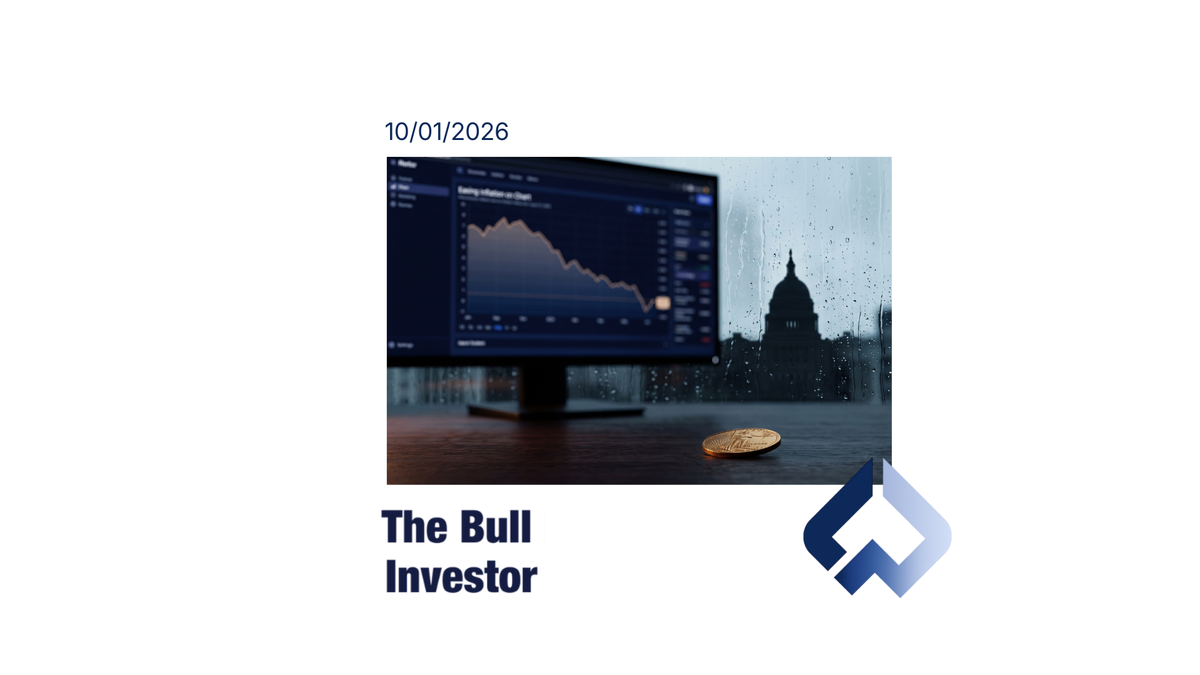
Inflation came in cooler than forecast, and the Dow still lost 443 points.
The Close
September closed on a sour note. The S&P 500 fell 19.30 points, or 0.3%, to 7,651.54 after spending most of the day higher. The Dow dropped 443.87 points, or 0.9%, to 50,906.05, dragged down by financials. The Nasdaq was the lone winner, adding 0.2% to 26,861.06.
What makes the fade interesting is the news that preceded it. The Fed's preferred inflation gauge came in cooler than economists expected, which is precisely what this market has been waiting weeks to hear. Stocks rallied on it, then gave the whole thing back.

One Big Thing
Start with what the report actually said. Personal consumption expenditures, the inflation measure the Fed targets, showed prices up 3.4% over the year to August. Economists had expected the rate to hold at 3.7%. Core prices, which strip out food and energy, rose 0.2% for the month and sit at 3.0% annually.
That is a genuine improvement on the forecast. Short-term Treasury yields fell as traders trimmed their bets on a rate rise this month. For a few hours the market behaved exactly as you'd expect.
Then it stopped. The reason is the distinction between two numbers that often get treated as one. A "beat" is measured against what economists guessed. The Fed's job is measured against 2%. Wednesday's report moved the first number and barely touched the second.
A surprise is measured against a forecast. A central bank is measured against a target. Only one of those improved on Wednesday.
Core inflation at 3.0% is still half again above where the Fed needs it. Long-term yields stayed stubbornly high because oil has not come down and the energy-driven price pressure has not resolved. Financial shares took the brunt of it, which is why the Dow fell almost a full percent on a day the Nasdaq rose.
Traders pared their expectations for an October move and kept expecting one in December. The destination didn't change. Only the timing did.
| What economists expected | 3.7% |
| What PCE actually came in at | 3.4% |
| Core PCE, annual rate | 3.0% |
| The Fed's target | 2.0% |
The celebrated distance is between the first two bars: three-tenths of a point. The distance that governs policy is between the bottom two: a full point. Markets traded the first gap for a morning and remembered the second by the close.
Sources: Associated Press and TheStreet, reporting the August PCE release, Sept. 30, 2026.
The Deeper Read
Here is the detail that kept me from getting comfortable. The report published Wednesday describes August. It landed five weeks after the month it measures had already ended.
That matters enormously this time, because September is when fuel costs really bit. Diesel reached a record price in the middle of the month and gasoline climbed with it. None of that is in the number the market celebrated. Analysts are already warning that the September reading, due at the end of October, could come in sharply higher for exactly that reason.
Oil rebounded again on Wednesday itself, which is part of why the early rally couldn't hold. So the good news is real and also stale. It tells you the economy was behaving reasonably before the worst of the energy squeeze arrived, which is useful history and a poor guide to October.
The month's scoreboard says something similar. The Dow lost 4.3% in September while the Nasdaq gained 1.9%, a five-point spread between two measures of the same market. Whatever you concluded about September depends almost entirely on which index you happened to be watching.

What This Means For You
Your household budget never experiences a beat. It experiences a level. Prices rose 3.4% over the year whether or not that was better than somebody's spreadsheet predicted, and the groceries cost what they cost.
The difference between 3% and 2% sounds academic until you run it over a retirement. At 3% a year, money loses half its buying power in roughly 24 years. At 2%, that takes about 36 years. A single percentage point is twelve years of purchasing power, which is the whole reason the Fed is still raising rates into a slowing inflation rate.
That arithmetic is also the argument against sitting entirely in cash just because cash finally pays something. A deposit earning 4% against 3% inflation leaves you barely ahead before tax, and behind it once the tax is paid. Closing that gap is the entire job your long-term money is hired to do.
The Long Game
Markets run on surprises because surprises are what move prices in the next hour. Economies run on levels, because levels are what people actually pay. Most of the confusion in financial news comes from those two clocks being reported in the same sentence.
A quarter has now closed, which is a good moment to notice that you own the second thing. Your plan does not care whether August beat a forecast. It cares what prices do over twenty years, and that question will not be settled by any single Wednesday morning release.
| ◆ |
— Anthony