🔹 Three in four stocks in the index rose Tuesday. The index itself gained 0.28%. Here’s why.
Stocks set fresh records as Hegseth confirms the Iran ceasefire and oil retreats nearly 4%.
| ◆ |
The Rally the S&P 500 Mostly Missed
Three in four S&P 500 stocks rose Tuesday. The index itself gained 0.28%.
The Close
The Dow Jones Industrial Average rose 529.85 points, or 1%, to 52,495.88. The Russell 2000, which tracks smaller American companies, gained 1.7% to 2,773.42. Health care led all eleven S&P 500 sectors to a record high. And the S&P 500 itself managed 21.84 points — 0.28% — to 7,712.57, while the Nasdaq Composite slipped 6.07 points to 26,424.82.
Nothing went wrong in the headline indexes yesterday. Something went right nearly everywhere else, and the index most Americans own is built in a way that barely registered it.

One Big Thing
The S&P 500 holds around five hundred companies, and it does not treat them equally. Each one counts in proportion to its market value, so the largest handful carry more weight than several hundred of the smallest put together. That design is invisible on an ordinary day. Yesterday it was the whole story.
Roughly three of every four companies in the index rose. Real estate gained 1.7%, utilities 1.2%, financials about 1%, and health care led all eleven sectors to a record. Against that: technology fell 0.3% and communication services fell 0.9%. Those two happen to be the heaviest sectors in the index. Meta dropped 1.6%. Nvidia, Microsoft and Broadcom finished roughly flat and contributed nothing either way.
Three quarters of the companies went up and the index barely moved. That is not a contradiction. That is the arithmetic working exactly as designed.
Hundreds of mid-sized gains, cancelled out by a few declines in the names that count for the most, leaves you with 0.28%. The Russell 2000's 1.65% is much closer to what a typical listed American company actually did on Tuesday, and it beat the S&P by the widest margin since June. The distance between those two numbers is a reasonable measure of how much of the index's day-to-day behaviour now comes from the top.
The Chart That Explains It
| Tuesday 20 Oct · change on the day, percent | ||||||||||||||||
| ||||||||||||||||
| Calculated from closing levels, Associated Press. |
Four measures of one session. The more a measure leans on the very largest companies, the less of Tuesday it captured. The Russell 2000 tracks smaller firms and rose 1.65%; the Nasdaq, dominated by the biggest technology names, finished fractionally lower. Same day, same market.
The Deeper Read
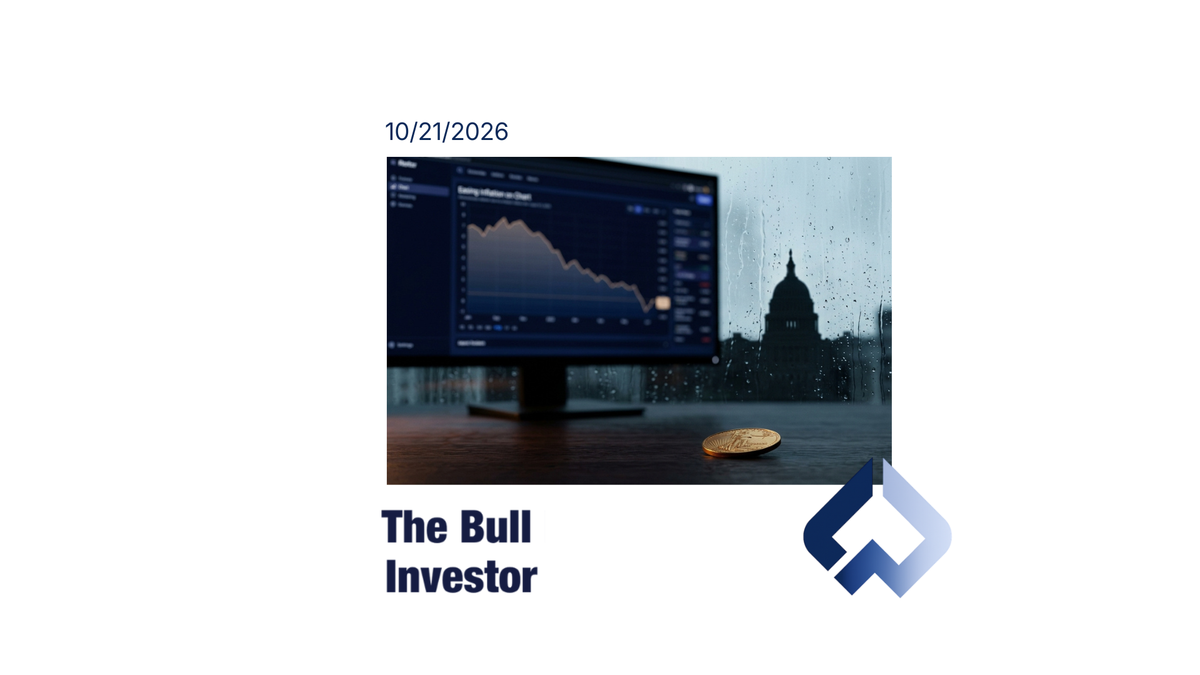
There was a reason behind the breadth, and it was in the bond market. Long-term Treasury yields fell: the thirty-year from 5.48% to 5.42%, the twenty-year from 5.53% to 5.47%, the ten-year from 5.15% to 5.12%. Short rates went the other way, with the two-year up to 4.79%. Long yields are what matter to businesses that borrow for decades and to anyone valuing dividends paid far into the future — property companies, utilities, smaller firms carrying debt. Those are precisely what rose.
But broad is not the same as blind. General Motors beat on revenue, at $50 billion against the $48.5 billion expected, beat on earnings at $3.70 a share, raised its free-cash-flow guidance and announced a $20 billion buyback. It closed down 6.8% at $77.09, because management warned of higher commodity costs and softer truck sales ahead. After the bell, Netflix beat on profit and guided fourth-quarter revenue slightly light; the shares fell about 5%.
Meanwhile 3M rose 5.8% on an expanded data-centre partnership with Amazon and a raised profit forecast. This was not a crowd buying a category. It was a market reading companies one at a time, and happening to like most of the ones nobody had been watching.

What This Means For You
If you own an S&P 500 index fund, Tuesday handed you a free measurement. On a day when roughly three of every four companies you hold went up, your money rose 0.28%. Nothing malfunctioned. Your stake simply is not spread evenly across five hundred businesses, and the slice that carries the most weight sat still.
That is not an argument against index funds. The weighting has served investors well for decades, and jumping between corners of the market based on one session is just trading with extra steps.
It is an argument for knowing the number. Every fund provider publishes its top ten holdings and their combined share of the fund, usually on the first page of the fact sheet. Go and look at yours. If the figure surprises you, far better to learn it on a quiet Tuesday than during a bad quarter for those ten companies. And if you also hold a total-market or small-company fund alongside it, this week is a decent reminder of why you bothered.
|
What Averages Hide
The Long GameA single number can describe a market faithfully or almost not at all, depending on the day. Tuesday's 0.28% was accurate and nearly useless. It said nothing about health care reaching a record, nothing about smaller companies having their best day against larger ones since June, nothing about long rates easing. Averages are built to smooth all of that away, and most of the time that is a kindness. The days it isn't are worth noticing — not because they ask anything of you, but because they show you what you own. |
| ◆ |
— Anthony
* This is a paid advertisement for Green Coffee Company's Regulation A offering. Please read the offering circular at https://invest.greencoffeecompany.com/. Timelines are subject to change. Listing on the NASDAQ is contingent upon necessary approvals, and reserving a ticker symbol does not guarantee a company's public listing.
No IPO is agreed, guaranteed, or scheduled, and plans may change at any time.