🔹 THE MARKET BLINKED. THE WAR DID NOT.
Oil seesawed near $100, gold bounced back, and dealmakers had their busiest quarter on record.
Good afternoon,
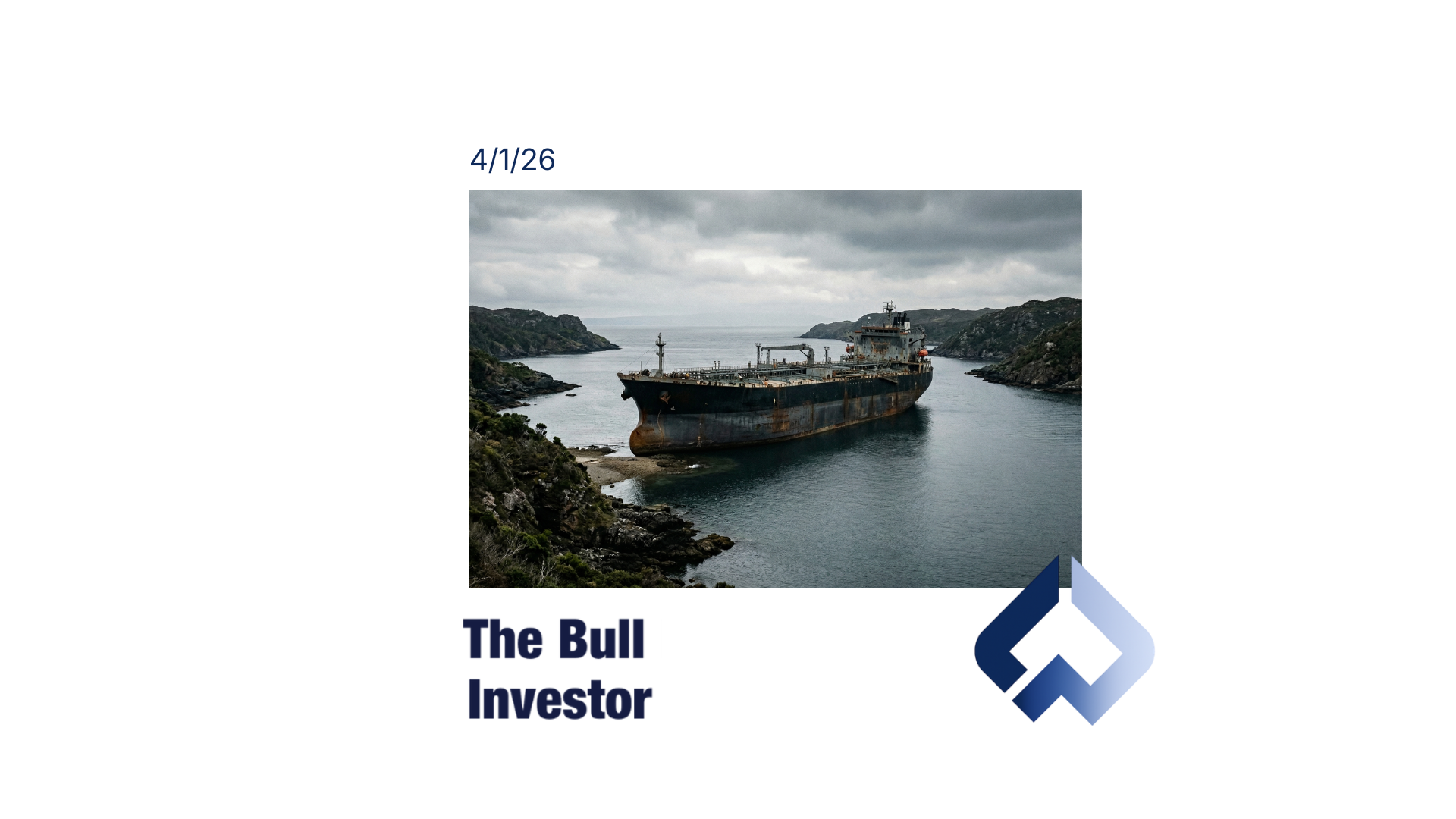
The week opened with Fed Chair Powell doing something markets desperately needed: being boring. Speaking at Harvard on Monday, he made clear that the Fed intends to sit still and look through the oil shock rather than chase it with higher rates. That single message rippled across bonds, equities, and commodities. Meanwhile, the Wall Street Journal reported that President Trump has signaled a willingness to end the Iran campaign, even if the Strait of Hormuz stays closed.
For investors focused on preserving purchasing power and building retirement income, the question this week is straightforward: does the end of shooting mean the end of inflation pressure? Probably not yet. But the direction of travel matters.
Getting started.

The Pulse

The 10-year Treasury yield fell to approximately 4.32% on Tuesday, sliding for a second straight session after Fed Chair Powell said long-term inflation expectations remain well-anchored despite the Iran war's energy shock. The probability of a 2026 Fed rate hike dropped from roughly 35% to 20%. Brent crude seesawed between $100 and $104 as Trump's exit signals competed with the IEA's warning that April will be worse than March for global oil supply.
Markets
- S&P 500 closed Tuesday at 6,528.52, up 2.91%, its strongest session since May, as hope around a U.S. withdrawal from Iran within "two or three weeks" lifted risk appetite across the board.
- Nasdaq futures climbed 0.63% to 24,065 at Wednesday's open, with Nvidia and Microsoft leading the mega-cap recovery as tech resumed its role as the engine of index performance.
- Treasury yields pulled back, with the 10-year reaching ~4.32% after gaining up to 40 basis points in March, easing fears about a rate hike cycle restarting in response to oil-driven inflation.
- Brent crude hovered near $104, seesawing through volatile intraday moves as markets tried to reconcile Trump's peace signals with the IEA's warning that 12 million barrels per day remain offline.
The March selloff was driven by something markets hadn't fully modeled: a genuine supply shock. Oil is not like tariffs. It hits prices immediately and broadly, touching everything from transportation to food to manufacturing inputs. That's the reason investors were nervous even as equities bounced. The underlying conditions haven't resolved. They've simply paused.
Earnings
- Nike (NKE) reported Q3 FY2026 revenues of $11.3 billion, essentially flat year-over-year and just ahead of the $11.27 billion consensus. But the headline number masked real pressure underneath. Diluted EPS fell 35% to $0.35 as gross margin contracted 130 basis points to 40.2%, driven primarily by higher North American tariff costs. Nike Direct sales fell 4%, and China revenues dropped 7%. Shares fell roughly 2.5% after hours. Management guided Q4 revenue down 2-4%, worse than the 2% growth Wall Street had expected. The turnaround is real in some pockets — North American wholesale grew 5% — but the tariff drag and China softness are meaningful headwinds for a company trying to rebuild margin momentum.
- Conagra Brands (CAG) reported Q3 FY2026 EPS of $0.42 (reported), beating the $0.40 estimate, with organic net sales up 2.4%. The company narrowed full-year adjusted EPS guidance to the low end of its $1.70-$1.85 range at approximately $1.70, signaling caution on the consumer environment.
- McCormick & Co. reported alongside its landmark Unilever food division acquisition. Investor focus now shifts to how absorbing Hellmann's, Knorr, and French's reshapes the company's debt load and long-term earnings structure.
Earnings season is still early, but the pattern is consistent: companies are navigating a squeeze from input costs, tariffs, and a consumer that's becoming more selective. That's worth watching for income-oriented investors who hold dividend payers across consumer staples and discretionary.
Gold & Silver Moves
Gold:
Gold closed March with its worst monthly performance since 2008, falling more than 10% as the Iran war sent oil, the dollar, and bond yields higher simultaneously. The metal's traditional role as a safe haven was complicated by the nature of this shock: an inflationary war, not a deflationary crisis. When inflation rises sharply, real yields can move up with it, and gold pays no income, so it tends to struggle against that backdrop.
By April 1, gold had recovered to approximately $4,654 per ounce, up around 2.8% on the day, as Iran peace optimism triggered a partial reversal of March's liquidation. JPMorgan maintained its end-2026 price target of $6,300 per ounce, citing continued central bank accumulation and the eventual normalization of speculative positioning. Goldman Sachs echoed that constructive view, noting that while the Iran selloff was real, the structural drivers of gold's multi-year bull run remain firmly in place: central bank diversification away from dollar assets, persistent deficit spending, and geopolitical fragmentation.
Silver:
Silver closed at approximately $75.23 per ounce on April 1, having fallen more than 19% in March, a significantly steeper decline than gold. Silver's sharper drawdown reflects its dual nature: it is both a monetary metal and an industrial one. When growth fears rise, industrial demand expectations fall, and silver gets hit on both fronts simultaneously.
The recovery in silver this week has been more tentative than gold's bounce, which tells you something about how investors are reading the risk environment. Confidence is returning at the margins. But markets are not yet convinced the economic disruption from this oil shock is behind us.

The Gold / Silver ratio currently sits near 61.9, meaning it takes approximately 62 ounces of silver to buy one ounce of gold.
That level is historically moderate. For context: the ratio spiked above 125 during the COVID-19 panic of 2020, reflecting extreme risk aversion. It averaged closer to 70-80 over most of the past decade. At 62, silver is not obviously cheap relative to gold by historical standards, but it is also not deeply overvalued.
What makes the current reading interesting is that silver fell much harder than gold in March (roughly 19% vs. 10%), which should have pushed the ratio higher, toward 65-70. The fact that it remains near 62 suggests gold fell faster in absolute terms from its January high of $5,602, reflecting the unwinding of heavy speculative positions that had accumulated during 2025's extraordinary 60%+ rally.
For investors, the ratio at this level sends a nuanced signal. Silver's steeper March decline points to genuine concern about industrial demand. A world where oil stays above $100 for months is a world where manufacturing and economic activity slow, reducing demand for silver in electronics, solar panels, and electric vehicles. That's a growth-sensitive story, not a monetary one.
Gold, meanwhile, is being pulled in two directions. The oil shock pushes inflation expectations up, which is typically bullish for gold, but also pushes real yields higher, which is a headwind. The net result has been elevated volatility, not a clean directional move.
If geopolitical tensions ease and the Strait of Hormuz reopens, silver is likely the metal with the more explosive catch-up potential. Its industrial fundamentals remain sound longer-term: solar adoption continues, EV demand is structural, and supply deficits have been documented for several consecutive years. The ratio could move back toward 55-58 in a risk-on recovery scenario. That said, none of that resolves on a weekly timeline.
The takeaway
At current prices, both metals have fallen meaningfully from their highs, and for investors focused on purchasing power protection over a multi-year horizon, the structural case for holding precious metals as a hedge against currency debasement and fiscal excess has not changed.
The Deal Room
M&A / Investments
- Unilever + McCormick, $44.8B. Unilever agreed to combine most of its food division (Hellmann's, Knorr, French's) with McCormick. McCormick pays $15.7B in cash and $29.1B in stock. Unilever shareholders retain 65% of the combined entity. (BBG)
- Sysco + Jetro Restaurant Depot, $29.1B. Sysco agreed to acquire cash-and-carry food wholesaler Jetro, adding 166 warehouse stores across 35 states. The deal is financed with $21B in new debt. Sysco shares fell ~12%. Fitch placed the company on "rating watch negative." (CNBC)
- Merck + Terns Pharmaceuticals, ~$6.7B. Merck agreed to acquire oncology-focused Terns at $53.00 per share in an all-cash deal, continuing the pharmaceutical sector's steady dealmaking pace ahead of key pipeline expirations.
- Paramount Skydance + Warner Bros. Discovery, $110B. Warner Bros. shareholders will vote on April 23 on the $111B all-cash offer from Paramount Skydance. WBD shares are trading roughly $4 below the $31 offer price, reflecting lingering regulatory uncertainty.
- Q1 2026 Global M&A hit $1.3 trillion, up nearly 20% from Q1 2025, the strongest start to a calendar year on record for dealmaking. (BBG)
Retirement Lens
The events of Q1 serve as a reminder of something that long-term investors often know intellectually but rarely experience so directly: supply shocks are different. Tariffs are a policy choice. A blocked shipping strait is a physical reality. The inflationary pressure from energy spreads through nearly every sector of the economy over weeks, not months, and it doesn't wait for central banks to respond.
For retirement-focused portfolios, the practical questions right now are familiar ones. How much of your fixed income exposure is short-duration, and therefore less vulnerable to yield spikes? Do you hold any inflation-sensitive assets (TIPS, commodities, or real assets) that could partially offset rising prices? Is your income stream (dividends, bond coupons, distributions) durable enough to hold its value through a period of elevated costs?
None of this requires predicting how the Iran situation resolves. It simply requires making sure the portfolio you hold today is one you can maintain with confidence through a period of uncertainty. That's always been the point.

Headline Hunt
- The national average US retail gas price crossed $4 per gallon for the first time since 2022, while diesel hit $5.45, up 45% since the Iran war began February 28.
- The IEA's Fatih Birol described the Iran war as the worst energy crisis in history, with 12 million barrels per day removed from global supply, more than the two 1970s oil shocks combined.
- Brent crude's March rally exceeded 60%, the largest monthly gain in oil prices since records began in 1988.
- The Fed kept rates at 3.50%–3.75% at its March 18 meeting and added new language acknowledging Middle East uncertainty, its first explicit reference to the Iran war in policy guidance.
- Bloomberg Economics' real-time tracker estimates US CPI jumped to 3.4% year-on-year in March, up sharply from 2.4% in February, with energy prices as the primary driver.
- EY-Parthenon's chief economist raised the probability of a US recession over the next 12 months to 40%, noting the economy entered the war shock with employers already cutting jobs.
- ISM Manufacturing prices paid sub-index was expected near 73.8 for March, up from 70.5 in February, indicating factory input cost pressures are intensifying as the oil shock spreads through supply chains.
- Trump extended the pause on US strikes against Iranian power plants and energy infrastructure to April 6, citing productive talks, though Iran denied direct negotiations are underway.
- Urea prices jumped 50% and ammonia 20% since the war began, with up to 40% of global nitrogen fertilizer exports transiting the Strait of Hormuz, creating a developing pressure on global food costs.
- Jerome Powell described stagflation fears as "premature," pushing back on 1970s comparisons and signaling the Fed views the current energy shock as a transitory supply disruption.
- Goldman Sachs maintains its end-2026 gold price target of $5,400 per ounce, citing continued central bank diversification and expected Fed rate cuts later in the year.
Recommended Reading
- Why the Iran War Is Reviving Stagflation Fears: A clear explanation of why this oil shock is structurally different from the tariff-driven inflation of 2025, and why it poses a harder policy problem. Useful for any investor thinking about how to position fixed income and inflation-sensitive assets for the rest of the year.