🔹 THE MARKET JUST LOST ITS LAST SAFE HAVEN
Stocks, bonds, and gold are falling in unison and that changes the retirement calculus.
Good afternoon,
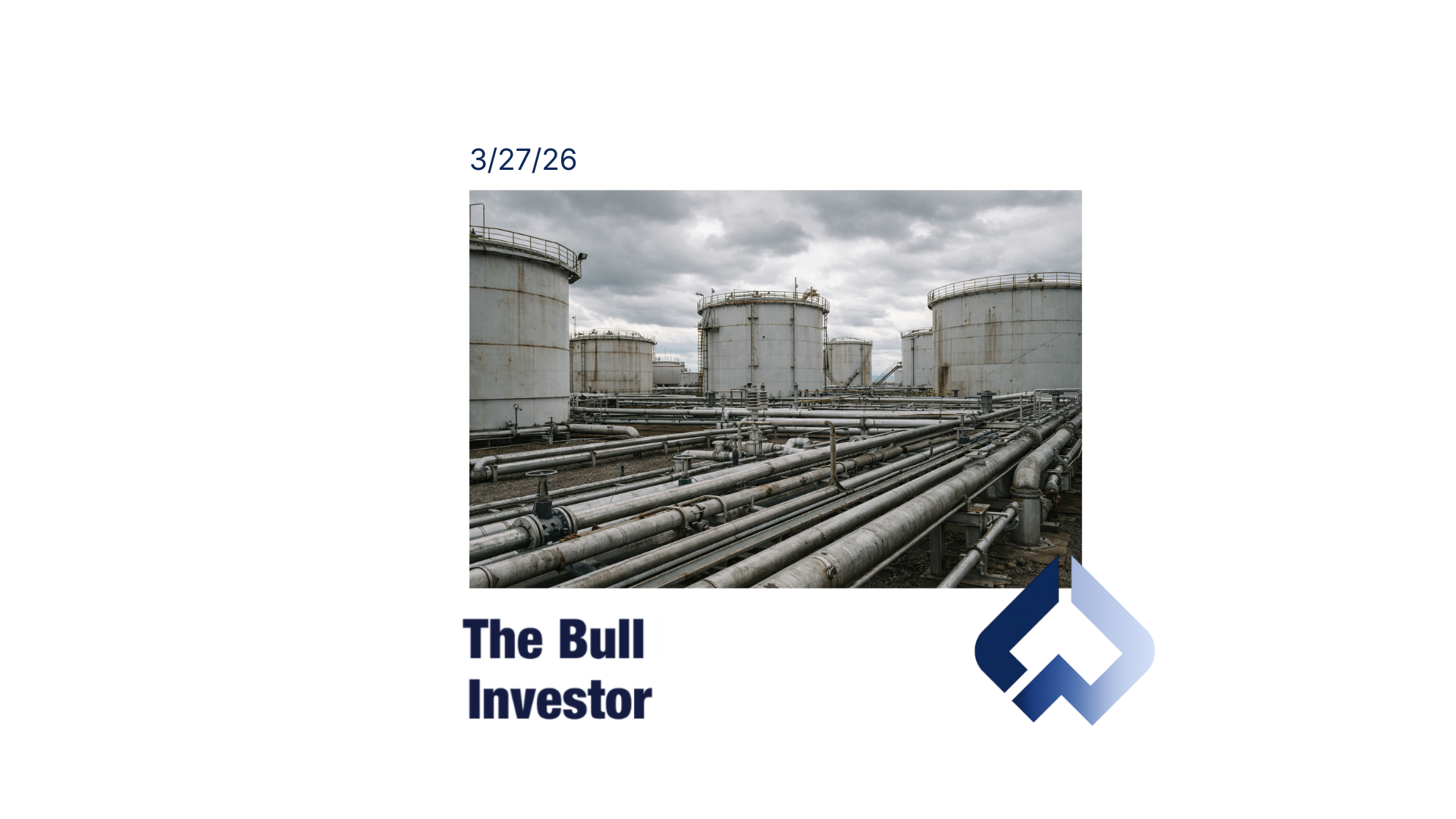
There is a phrase traders use when nothing is working: there's nowhere to hide. This week, that phrase became literal. Stocks fell. Bond prices fell. Gold fell. Oil climbed past $110 a barrel, and the Nasdaq slipped more than 10% from its peak — the textbook definition of a correction.
The culprit is a war now entering its fourth week with no clear off-ramp. The Strait of Hormuz remains largely closed. The OECD raised its U.S. inflation forecast to 4.2% for this year. Goldman Sachs put the odds of a recession in the next twelve months at 30%.
For investors thinking about the long run — retirement savings, income stability, purchasing power — weeks like this are not reasons to act. They are reasons to understand. Today's issue walks through what moved, what it means, and where the calmer parts of the picture still exist.
Getting started.

The Pulse

Markets
- The S&P 500 fell 1.74% to 6,477 on Thursday, its worst session in two months. The Nasdaq dropped 2.38%, entering correction territory — more than 10% below its October peak.
- Technology and semiconductors led losses. Meta fell roughly 8% following dual court defeats. AMD dropped 7.5%, Nvidia shed 4.2%, Alphabet lost 3%. Energy names were among the few gainers.
- The OECD raised its U.S. inflation forecast to 4.2% for 2026, up sharply from a prior estimate of 2.8% — the highest projected rate among major economies.
- Goldman Sachs raised its 12-month U.S. recession probability to 30%, forecasting unemployment rising to 4.6% and full-year GDP growth near 2.1%.
The common thread running through this week is stagflation risk — the uncomfortable combination of slowing growth and rising prices. When oil is the source of inflation, it is particularly difficult for central banks to respond. Cutting rates would stoke prices further. Raising them risks slowing an economy already absorbing an energy shock. The Fed remains on hold, which is the correct posture for now, but it narrows the room for maneuver considerably.
Earnings
- Carnival Corporation (CCL) reported Q1 2026 results this morning before the bell. Analysts had expected EPS of around $0.18–$0.19 and revenues near $6.15 billion — a roughly 40% improvement in earnings year-over-year. The key question was management commentary on fuel costs and forward bookings in the context of rising oil prices and war-related disruption in travel patterns.
- Cintas (CTAS) posted record Q3 revenues of $2.84 billion, up 8.9% year-over-year, with diluted EPS of $1.24 beating estimates. The company raised full-year revenue guidance to $11.21–$11.24 billion and confirmed its pending acquisition of UniFirst. Stock rose roughly 2.5% pre-market.
- Meta faces a more complex earnings backdrop ahead after two jury verdicts this week — a $6 million damages award in Los Angeles and a $375 million penalty in New Mexico — opening the company to potential liability across 2,000+ pending lawsuits.
Cintas is a useful reminder that fundamentals can hold even in a difficult market. Companies with sticky, essential services tend to weather volatility better than those priced on future growth alone.

- This week's lineup:
- Today: Carnival
Gold & Silver Moves
Gold:
Spot gold is trading near $4,430–$4,470 per ounce today, recovering slightly after Trump's extended Iran deadline offered brief relief. Yesterday, gold futures settled down roughly 4%, near $4,376.
Since the Iran war began in late February, gold has fallen approximately 17% from its all-time high above $5,500 reached in January. That decline has surprised many investors who expected geopolitical turmoil to support the metal.
The explanation is practical. Gold is falling alongside stocks, not because it has lost its long-term value, but because investors under pressure sell what is liquid. When margin calls come in or portfolios need rebalancing, gold gets sold. Higher Treasury yields — the 10-year is now at 4.45% — also reduce the appeal of a non-yielding asset. A stronger dollar compounds the effect. Standard Chartered's head of commodities research noted that gold is acting as an easy source of liquidity, a dynamic that could continue for another four to six weeks. (CNBC)
Silver:
Spot silver is trading near $68–$70 per ounce today, recovering modestly after falling as much as 44% from its January all-time high of $121.64. Yesterday silver futures lost more than 8% in a single session.
Silver is taking a harder hit than gold for a specific reason. It carries both monetary and industrial characteristics. When growth fears rise — as they are now — industrial demand expectations fall, adding selling pressure that gold does not face to the same degree.

The Gold / Silver ratio currently sits near 63:1 to 65:1, meaning it takes roughly 63 to 65 ounces of silver to buy one ounce of gold.
To put that in context: historically, a ratio above 80 has often been associated with recession fears or extreme risk-off conditions, while a ratio in the 40–50 range typically reflects periods of economic confidence and strong industrial demand. A reading in the mid-60s is elevated, but not yet at the crisis extremes seen in March 2020, when the ratio briefly surged past 120.
What the current level tells us is that markets are pricing silver as a weaker asset in this environment. That makes sense when you consider that silver derives roughly 59% of its demand from industrial uses — solar panels, electronics, medical equipment. When growth slows, or when investors fear it will slow, silver tends to underperform gold because that industrial demand premium disappears.
At the same time, the ratio at these levels has historically been a signal that silver is significantly undervalued relative to gold on a mean-reversion basis. In prior cycles — 2009, 2016, and 2020 — a ratio above 60 preceded extended periods of silver outperformance once risk sentiment stabilized.
The catalyst needed for that reversal is a reduction in rate-hike fears, a ceasefire in Iran, or a credible return of growth expectations. None of those is visible today. But patient investors have noted these setups before.
The takeaway: In periods of inflation and geopolitical uncertainty, both metals serve as long-term stores of purchasing power — but their short-term behavior depends heavily on what is driving markets, and right now it is liquidity pressure and higher real yields, not a fundamental rejection of hard assets.
The Deal Room
- Merck agreed to acquire oncology firm Terns Pharmaceuticals for $6.7 billion ($53/share cash), gaining access to TERN-701, a promising leukemia treatment, ahead of Keytruda's patent expiry. Deal expected to close in Q2. (Bloomberg)
- Danaher confirmed its acquisition of Masimo Corporation for approximately $9.9 billion ($180/share), a ~40% premium, expanding its diagnostics portfolio with AI-assisted patient monitoring technology. Expected close: H2 2026. (Danaher IR)
- Hg Capital is taking OneStream private in a $6.4 billion all-cash deal, two years after the corporate performance management software firm's IPO — a classic private equity bet on high-retention enterprise software. (DealRoom)
- BlackRock/EQT completed a $10.7 billion acquisition of AES Corporation, reflecting continued institutional conviction that AI-driven energy demand makes utility infrastructure a compelling long-term asset. (Wall Street Horizon)
- Q1 2026 global M&A hit a record $813.3 billion, with megadeal volume (transactions above $1B) up 57% year-over-year — concentrated in technology, healthcare, and energy. (Financial Content)
Retirement Lens
This week offers a practical reminder about portfolio construction. The instinct in moments like this is to look for somewhere safe to move capital. But this week showed that the usual shelters — gold, government bonds, even cash-adjacent assets — are all responding differently than historical playbooks suggest.
For long-term investors, that is not necessarily alarming. It is clarifying. Diversification is not about finding an asset that always goes up. It is about holding things that respond to stress in different ways, and at different times.
The businesses generating real cash flows — recurring services, essential healthcare, energy infrastructure — are showing more resilience than growth-dependent technology. That pattern has shown up before in inflationary periods, and it is worth observing calmly rather than reacting quickly.
Inflation at or above 4% erodes purchasing power in ways that feel gradual until they do not. Staying invested in assets with genuine pricing power, while avoiding the temptation to make sudden moves based on a week's headlines, remains the quieter and often more effective posture.

Headline Hunt
- The IEA called the Iran war's supply disruption the "greatest global energy security challenge in history," with global oil supply projected to fall 8 million barrels per day in March as Hormuz flows collapse.
- Average U.S. gasoline prices jumped from $2.98 to $3.98 per gallon since the war began; the average 30-year fixed mortgage rate rose to 6.38%, a six-month high.
- The FOMC's March "dot plot" still projects one 25-basis-point cut for 2026, with seven of 19 members expecting no cuts at all this year.
- Federal Reserve Chair Powell's term ends in May; Trump has nominated former Fed Governor Kevin Warsh as successor, adding institutional uncertainty to an already complex monetary policy picture.
- Clear Secure (CLEAR) has risen more than 20% in two weeks as partial government shutdown-related TSA delays drive app downloads to triple their prior-year pace.
- UBS downgraded fertilizer producers Mosaic and Nutrien, citing rising sulfur and ammonia input costs linked to the Iran conflict that outweigh commodity price tailwinds.
- Iran rejected a U.S. 15-point peace proposal, submitting its own conditions including recognition of Tehran's authority over the Strait of Hormuz — deepening uncertainty over any near-term resolution.
- Turkey's central bank sold and swapped approximately 60 tons of gold — worth more than $8 billion — during the first two weeks of the war, marking a sharp drawdown in its reserves.
- March PMI surveys across the U.S., eurozone, Australia, and India simultaneously showed growth deceleration and rising prices — the clearest macro evidence yet of the war's stagflationary transmission.
- Cintas confirmed it entered an agreement on March 10 to acquire UniFirst, a deal that, if completed, would create the dominant player in U.S. uniform and workwear services.
Recommended Reading
- War Knocks Global Economy With Dual Shock to Growth and Price: The clearest macro summary of how business surveys across four major economies are simultaneously showing contraction and price acceleration — the textbook definition of a stagflationary impulse, and the framework that will likely drive central bank decisions for the rest of the year. (Bloomberg)