🔹 TWO WEEKS TO MAKE OR BREAK A DEAL
A last-minute Iran deal sent oil plunging and stocks surging overnight.
Good afternoon,
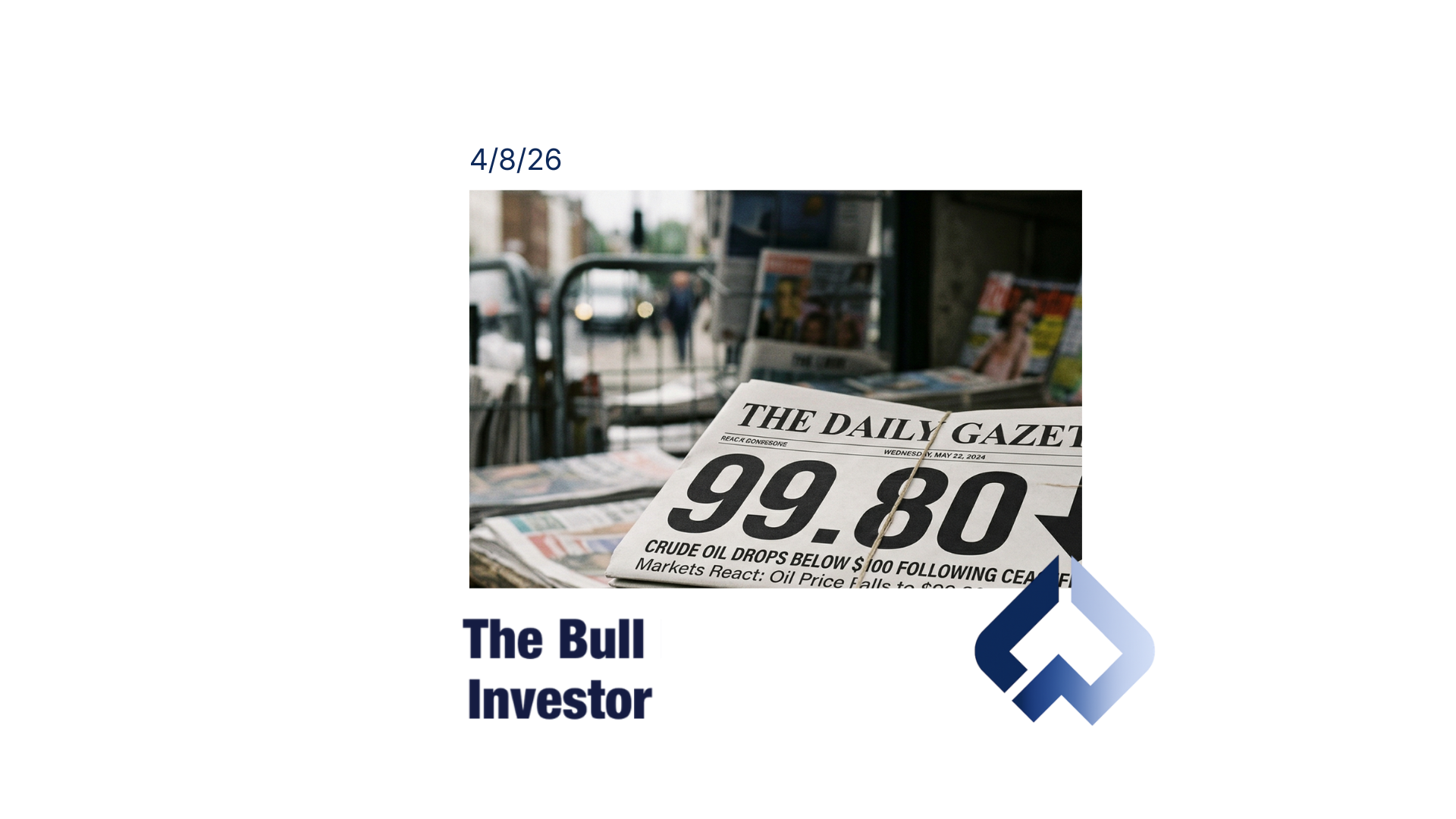
Late Tuesday evening, the United States and Iran agreed to a two-week ceasefire, and markets responded immediately. Oil fell below $100 for the first time since early March. Stock futures surged overnight. The dollar weakened. For weeks, the Strait of Hormuz crisis had been the dominant force in global markets, inflating energy costs and clouding the outlook for everything from inflation to Fed policy. That cloud hasn't lifted entirely, but for the first time in over a month, there's a visible path toward resolution.
For those focused on retirement security, the question now is whether this reprieve can hold — and what it means for the inflation picture that still looms over portfolios.
Getting started.

The Pulse

The ceasefire is the signal. After five weeks of war-driven volatility, S&P 500 futures jumped 2.3% in after-hours trading. WTI crude collapsed 14.3% to $96.83 per barrel. Brent fell 13.3% to $94.74. The 10-year Treasury yield edged lower as risk appetite returned. Asia opened sharply higher overnight, with the Nikkei up 4.8% and South Korea's Kospi gaining 5.6%.
Markets
- The S&P 500 erased a 1.2% intraday loss to close up 0.08% at 6,616.85 on Tuesday. The Nasdaq added 0.1%. The Dow slipped 85 points. The late-session recovery came after Pakistan proposed a two-week extension to Trump's Iran deadline, which both sides accepted hours later.
- Oil prices crashed after the ceasefire was confirmed. WTI futures fell 14.3% to $96.83 and Brent dropped 13.3% to $94.74 — both below $100 for the first time since early March. The EIA warned that full restoration of Hormuz oil flows will take months, even under favorable conditions.
- The energy sector has rallied 34% year-to-date, with Exxon Mobil up roughly 42%, but traders on CNBC's Halftime Report flagged growing caution. If the ceasefire leads to a broader deal, the energy trade may reverse quickly.
- The Magnificent Seven continue to underperform. JPMorgan noted these stocks are hovering near fresh relative lows versus the S&P 500. Apple fell nearly 4% on reports of foldable iPhone engineering setbacks, though Bloomberg later said the September launch remains on track.
The ceasefire changes the short-term calculus. If the Strait of Hormuz reopens even partially, oil prices could continue falling, easing one of the main forces behind the recent inflation acceleration. But the deal is fragile. Iran's terms include controlled passage under its military coordination, and Israel has already said Lebanon is not covered. Markets will trade every headline for the next two weeks.
Earnings
- Levi Strauss beat estimates comfortably, posting adjusted EPS of $0.42 versus $0.37 expected, on revenue of $1.74 billion (up 14% year-over-year). Direct-to-consumer sales crossed 52% of total revenue for the first time. The company raised full-year guidance, now expecting adjusted EPS of $1.42 to $1.48. (CNBC)
Earnings season begins in earnest next week. The real test comes when the major banks report. If credit conditions have tightened or loan-loss provisions have climbed, the optimistic 13% growth forecast may need revision.

This week's lineup:
- Wednesday: Delta Air Lines, Constellation Brands
Gold & Silver Moves
Gold:
Gold June futures opened at $4,678.60 on Tuesday and traded in a tight $4,650–$4,680 range for most of the session as markets waited on the Iran deadline. By late Tuesday, after the ceasefire was confirmed, spot gold surged to approximately $4,814 per ounce as the dollar weakened sharply.
The move may seem counterintuitive. A ceasefire should, in theory, reduce safe-haven demand. But gold's rally was driven less by fear and more by the dollar. As the greenback fell on the news, gold became cheaper for international buyers. The ceasefire also revived expectations — however tentative — that the Fed could eventually resume cutting rates if oil-driven inflation begins to cool. Gold benefits from that narrative.
On a structural level, central bank buying continues to provide a floor. China's PBOC added to its gold reserves for the 17th consecutive month in March. Goldman Sachs maintains a year-end target of $5,400 per ounce, driven by this institutional demand and what they see as an ongoing de-dollarization trend.
Silver:
Silver spot traded near $73 per ounce during Tuesday's session, up modestly. Late Tuesday, it climbed to approximately $77.36. Silver's gains outpaced gold's in percentage terms, consistent with its higher beta and its sensitivity to both monetary and industrial demand shifts.
Silver's year-over-year performance has been extraordinary — up more than 150%, having reached an all-time nominal high of $121.67 in January 2026. But the recent pullback from those highs reflects the same tension as gold: the war premium created volatility, and rising rate expectations pushed leveraged speculators out.

The Gold / Silver ratio currently sits near 62, calculated from late-Tuesday prices of roughly $4,814 for gold and $77.36 for silver. This is notable. Over the past several years, the ratio has ranged broadly between 60 and 100, and at 62 it is near the lower end of that range.
A lower ratio means silver is relatively expensive compared to gold — or, viewed differently, that silver has been gaining ground faster. Historically, ratios below 65 have often coincided with periods of strong industrial demand, rising inflation expectations, and speculative enthusiasm in metals markets. All three conditions are present today. Silver's dual role as both a monetary metal and an industrial input — used in electronics, solar panels, and medical devices — has attracted capital from both camps.
The ratio also reflects risk sentiment. When investors are fearful, they tend to favor gold over silver, pushing the ratio higher. A ratio near 62 suggests that despite the war and inflation concerns, there is meaningful confidence in economic activity — or at least in the sectors that consume silver. That said, the ratio compressed quickly from around 65 in late March, which means the current level carries some short-term reversion risk if the ceasefire falters or industrial demand softens.
For metals investors watching relative value, the ratio suggests silver may have run ahead of gold in the near term. But the structural story — central bank buying for gold, industrial demand for silver, and persistent inflation for both — remains intact.
The takeaway: Both metals continue to serve as hedges against purchasing power erosion, which remains the core concern for anyone building or preserving retirement wealth.
The Deal Room
M&A / Investments
- Pershing Square bid $64.4 billion for Universal Music Group in a cash-and-stock offer representing a 78% premium. Bill Ackman plans to merge UMG with his SPARC vehicle and relist on the NYSE. UMG U.S. shares surged 13%.
- Intel joined Elon Musk's TeraFab AI chip project alongside Tesla, SpaceX, and xAI. Intel will provide manufacturing expertise to the initiative, which aims to produce 1 terawatt per year of AI compute. Intel shares rose about 3%.
- Broadcom expanded its AI partnerships with Alphabet and Anthropic, rising roughly 6% on the day. The agreements cover custom TPU chips and additional compute capacity.
IPO / Listings
- SpaceX's confidential IPO filing is drawing intense attention. Reuters reports a potential $75 billion raise at a valuation near $1.75 trillion, which would make it the largest listing in history. Analysts warn it could crowd out other 2026 IPOs.
- Madison Air Solutions raised $2.2 billion in its IPO, pricing 82.7 million shares at $25–$27. The indoor air company posted $3.3 billion in revenue last year.
Retirement Lens
The ceasefire is welcome news, but it doesn't resolve the underlying challenges. Oil may fall further, which would ease pressure at the pump and in CPI data. But the EIA warned that full normalization of Middle East oil flows could take until late 2026. Inflation is not going away quickly.
For retirement-focused portfolios, the key takeaway is that diversification continues to earn its place. Energy exposure has been the best performer this year. Gold and silver remain anchored by structural demand. Fixed income still offers real yield. And the repricing of Big Tech valuations may eventually create entry points for patient investors.
The next two weeks will determine whether this ceasefire becomes a turning point or another delay. Either way, the principles remain the same: preserve capital, protect against inflation, and stay positioned for a range of outcomes.

Headline Hunt
- Chicago Fed's Goolsbee said inflation is moving "from orange to red" and warned of a stagflationary energy shock.
- CME FedWatch now prices zero Fed rate cuts in 2026. Cleveland Fed's Hammack signaled openness to rate hikes if inflation remains above target.
- China and Russia vetoed a UN Security Council resolution aimed at authorizing measures to reopen the Strait of Hormuz.
- February durable goods orders fell 1.4%, worse than the expected 1.1% decline. Orders excluding transportation rose 0.8%.
- Microsoft announced a $10 billion investment in Japan's AI infrastructure over the next three years, partnering with SoftBank and Sakura Internet.
- Arm Holdings fell nearly 6% after Morgan Stanley downgraded the stock to equal-weight, cutting the price target to $135 on timeline concerns.
- The EIA expects U.S. gasoline prices to peak at $4.30 per gallon this month and warned that Middle East production shut-ins won't normalize until late 2026.
- Bloomberg reported growing stress in private credit markets, with a wave of retail fund withdrawals raising concerns about hidden risks.
- The March CPI report, due April 10, is expected to show prices rising at a 3.1% annual pace, up from 2.4% in February.
Recommended Reading
- US Inflation Shows Worrying Parallels With 2022 Price Surge. Bloomberg draws uncomfortable comparisons between the current energy-driven inflation spike and the conditions that forced aggressive Fed tightening in 2022. Worth reading for anyone assessing how long this inflationary cycle might persist.
- Blockbuster SpaceX Listing Could Suck Oxygen Out of Fragile IPO Market. Reuters examines how a record-breaking SpaceX debut could crowd out other listings, drawing on the chilling effect Facebook's 2012 IPO had on deal flow. Relevant for investors watching the IPO pipeline.